








Water-Cooled vs. Air-Cooled Centrifugal Compressors: Which Is Right for Your Facility?
novembro 24, 2026

Air-cooled centrifugal compressors deliver oil-free compressed air without an external cooling water supply, making them an attractive option for facilities where water availability or cooling infrastructure limits equipment choices. Water-cooled centrifugal compressors remain a strong choice where suitable cooling water is available. Choosing between them requires comparing site conditions, installation requirements, and total system operating costs.
Cooling plays a critical role in centrifugal air compressor performance, directly influencing energy efficiency, reliability, and operating costs. In multistage centrifugal compressors, intercoolers remove much of this heat between compression stages, while aftercoolers and lubricating oil coolers manage additional heat. Maintaining lower interstage temperatures helps reduce power consumption, preserve compressor capacity, and support efficient operation.
Both air-cooled and water-cooled centrifugal compressors deliver ISO 8573-1 Class 0 oil-free compressed air, but they differ in how heat is removed and the infrastructure required. While water-cooled systems have long been established in industrial applications, advancements in air-cooled technology offer facilities greater flexibility in meeting their compressed air requirements. Understanding these differences is essential when evaluating energy efficiency, cooling infrastructure, water availability, and long-term operating costs.
Prefere ouvir em vez disso? Join us on Beyond Compression as we compare water-cooled and air-cooled centrifugal compressors and discuss how to choose the right option for your facility.
Water-Cooled Centrifugal Compressors
Water-cooled compressor centrífugo transfer heat from compressed air and lubricating oil into circulating cooling water through heat exchangers. Cooling water may be supplied by a cooling tower, closed-loop cooler, chiller, or another available source, such as a river or municipal water supply.
Cooling towers can deliver water temperatures approaching the ambient wet-bulb temperature, which is typically lower than the dry-bulb temperature. Combined with water’s high heat capacity and efficient heat-transfer properties, this allows for compact heat exchangers and lower, more consistent interstage temperatures.
These cooling advantages can reduce compressor power requirements, particularly during warmer weather, making water-cooled systems attractive for facilities with existing cooling infrastructure and sufficient capacity.
However, facilities requiring new cooling infrastructure may need additional cooling towers, pumps, piping, water treatment, and associated controls. These requirements should be considered when evaluating total installation expenses, operating costs, and long-term system efficiency.
Additional Considerations
- Water Consumption and Costs: Water makeup, treatment, blowdown, and potential disposal expenses can increase ongoing operating costs.
- Cooling System Energy Consumption: Circulation pumps and cooling tower fans contribute to total system energy usage beyond the compressor itself.
- Cooling Performance: Scaling, corrosion, biological fouling, or elevated cooling water temperatures can reduce heat transfer efficiency and increase compressor power consumption.
For facilities without existing cooling capacity, these additional utilities and operating expenses can significantly affect total cost of ownership.
Air-Cooled Centrifugal Compressors
Air-cooled centrifugal compressors use ambient air to remove heat through finned heat exchangers and cooling fans, eliminating the need for an external cooling water supply. Heat is discharged into the surrounding environment or directed outdoors through properly designed ventilation or ducting.
Unlike water-cooled systems, which can take advantage of lower wet-bulb temperatures, air-cooled systems rely on ambient dry-bulb temperatures. Because air has a lower heat capacity than water, larger heat exchangers and greater airflow are generally required to achieve effective cooling. As a result, interstage temperatures are more dependent on ambient conditions, particularly during warmer weather, which can influence compressor efficiency and capacity.
Modern air-cooled centrifugal compressors incorporate high-efficiency intercoolers and optimized airflow designs to maintain effective heat transfer and manage energy consumption.
Advantages of Air-Cooled Technology
Air-cooled centrifugal compressors offer significant advantages for facilities where cooling water is limited, expensive, or unavailable. They are particularly valuable in arid or drought-prone regions, remote locations, and plants looking to expand compressed air capacity without additional cooling water infrastructure.
Key advantages include:
- Water Conservation: Eliminates cooling water consumption, treatment, and blowdown, supporting sustainability initiatives and water reduction goals.
- Lower Water-Related Operating Costs: Reduces expenses associated with water treatment, cooling tower maintenance, and supporting equipment.
- Installation Flexibility: Simplifies retrofits and facility expansions by eliminating the need for additional cooling towers, pumps, and piping, potentially reducing project costs and timelines.
While these advantages make air-cooled technology an attractive alternative, proper ventilation remains essential. High ambient temperatures, restricted airflow, dirty cooler fins, or recirculated discharge air can increase interstage temperatures, reduce efficiency, and trigger high-temperature alarms.
Air-Cooled vs. Water-Cooled: Key Differences
| Consideration | Water-Cooled | Air-Cooled |
| Cooling method | Circulating water | Ambient air and fans |
| Energy efficiency | Generally lower compressor power requirements | Ambient-dependent; fan energy |
| Infrastructure | Towers, pumps, piping | Integrated cooling; ventilation |
| Water consumption | Cooling water and makeup | None for cooling |
| Operating costs | Water, treatment, pumping | Fan energy and ventilation |
| Manutenção | Water treatment; tower upkeep | Cooler and fan cleaning |
| Heat recovery | Heated water for process or facility use | Warm air for space heating |
| Space and noise | Compact package; remote equipment | Larger package; fan noise |
Both technologies offer advantages depending on facility utilities, operating conditions, and the total installed system.
Maintenance and Installation Considerations
While cooling methods differ, the compressor’s airend and core components, including impellers, gearbox, bearings, seals, and lubrication system, require similar maintenance regardless of cooling technology. Air cooling essentially trades a water-treatment program for routine cooler and fan cleaning.
Water-cooled systems require ongoing monitoring to prevent scaling, corrosion, and biological growth that can reduce heat transfer efficiency and increase energy consumption. Air-cooled systems require regular inspection of intercoolers, fans, motors, and ventilation components to prevent airflow restrictions and maintain performance.
Installation requirements also extend beyond the compressor package. Water-cooled systems may require additional engineering, permitting, piping, and contractor coordination, while air-cooled systems can simplify project planning by eliminating much of this infrastructure.
For air-cooled installations, proper ventilation and equipment clearance are essential to prevent hot-air recirculation and elevated operating temperatures. Facilities with high ambient temperatures or airborne contaminants may require additional ventilation or more frequent cooler cleaning.
System reliability should also be considered. Water-cooled compressors connected to centralized cooling infrastructure may be affected by shared equipment failures, while air-cooled systems operate independently of centralized cooling water systems.
Understanding Cooling Costs, Energy Efficiency, and Heat Recovery
Compressor power alone does not capture total cooling-system energy use. A complete evaluation should include circulation pumps and cooling tower fans for water-cooled systems, or cooling fans and ventilation for air-cooled systems, along with applicable water, treatment, maintenance, installation, and disposal expenses.
Existing infrastructure can significantly influence operating costs. Water cooling may be economical when central cooling capacity is available, while air cooling may offer greater savings when new water infrastructure would otherwise be required. Utility rates, operating hours, ambient conditions, and heat recovery opportunities also affect long-term costs.
Evaluating Potential Heat Recovery Savings
Approximately 80–93% of a compressor’s electrical input becomes heat, presenting opportunities for energy recovery. Depending on system design and operating conditions, well-designed heat recovery systems can capture 50–90% of this energy for space heating, process water, or boiler makeup water heating.
For example, consider a 350 hp compressor with an electrical input of approximately 277.5 kW, operating 6,240 hours annually.
- Heat Recovery: 50% of electrical input
- Annual Recovered Energy: Approximately 866,000 kWh
- Boiler Efficiency: 80%
- Natural Gas Cost: $5 per MMBtu
- Estimated Annual Fuel Savings: $18,500
Larger compressors may offer even greater savings. Under similar operating assumptions, estimated annual savings could reach approximately $27,100 for a 500 hp compressor and $54,200 for a 1,000 hp compressor.
Water-cooled systems can recover heat from warmed cooling water for process or facility heating, while air-cooled systems can utilize heated airflow for space heating or other suitable applications. Actual savings depend on recovery efficiency, available temperatures, and whether the facility has a consistent heating demand that aligns with compressor operation.
Evaluating heat recovery alongside energy consumption, cooling infrastructure, and maintenance costs provides a more complete understanding of each technology’s total lifecycle costs.
Choosing the Right Cooling Technology
Selecting between air-cooled and water-cooled centrifugal compressors requires evaluating existing infrastructure, operating conditions, energy efficiency, and long-term costs.
Water-cooled systems remain a strong choice for facilities with established cooling infrastructure, particularly in high-temperature environments or applications that benefit from year-round heat recovery. Air-cooled systems offer advantages where cooling water is limited, costly, or unavailable. They can also simplify installation, reduce water-related maintenance, and help facilities minimize water consumption.
To determine which approach best fits your facility, review these factors with your compressor supplier:
- Air demand: Required airflow, discharge pressure, and anticipated future capacity needs.
- Site conditions: Maximum ambient temperature and site elevation.
- Cooling water: Available capacity, supply temperature, and water quality, where applicable.
- Installation requirements: Ventilation, heat discharge, and equipment clearances.
- Operating environment: Dust or other airborne contaminants that could affect cooler performance and cleaning frequency.
- Lifecycle costs: Installation expenses, annual operating hours, utility rates, maintenance requirements, and opportunities for heat recovery.
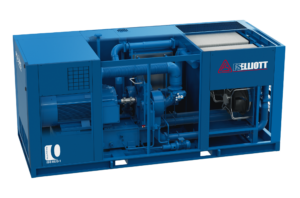
Advancements in air-cooled technology, including the FS-Elliott Polaris® P300 AC air-cooled centrifugal compressor, provide industrial facilities with greater flexibility. Featuring high-efficiency intercoolers, VFD-controlled cooling fans, and a maintenance-friendly design, the P300 AC delivers reliable, ISO 8573-1 Class 0 oil-free compressed air without cooling water. Its integrated cooling system offers a practical alternative to traditional water-cooled compressors while maintaining the efficiency, reliability, and lifecycle benefits of centrifugal technology.
Find the Right Cooling Solution for Your Facility
Talk with our team about air-cooled and water-cooled centrifugal compressors to determine the best fit for your operating requirements, cooling infrastructure, and long-term costs.
Perguntas frequentes
Are air-cooled centrifugal compressors as efficient as water-cooled compressors?
Water-cooled compressors generally achieve lower compressor-specific power because cooling water can maintain lower interstage temperatures. However, an accurate system comparison also includes cooling tower and pump energy on the water-cooled side and cooling fan energy on the air-cooled side.
Do air-cooled centrifugal compressors require cooling water?
No. Air-cooled centrifugal compressors reject heat through air-side heat exchangers and fans, eliminating the need for an external cooling water supply. Proper ventilation is still required.
Why are air-cooled compressors beneficial in water-scarce regions?
They avoid cooling water consumption, treatment, and discharge requirements, making them useful where water is limited, expensive, or subject to conservation targets.
Can centrifugal compressor heat be recovered?
Yes. Water-cooled systems can provide heated water for process or building uses, while air-cooled systems may provide warm air for space heating. Actual savings depend on heat recovery design and facility demand.
Você também pode gostar
Continuar lendo

A FS-Elliott apresenta o Polaris® P300 AC, oferecendo um desempenho centrífugo livre de óleo sem a necessidade de resfriamento da água
A FS-Elliott apresenta o Polaris® P300 AC, um compressor centrífugo de ar com capacidade de 900–2.220 cfm e classe de óleo livre ISO 8573-1 0. Seu design oferece aos fabricantes a flexibilidade de instalar um novo compressor ou expandir a capacidade sem precisar adicionar conexões para água de refrigeração.


AeroSwap & FlowFit | Airflow Conversion & Compressor Planning
Discover how FS-Elliott’s AeroSwap and FlowFit online tools simplify airflow conversions and centrifugal compressor capacity planning in this FS-Elliott University video.

Otimização do ciclo de vida de compressores de ar centrífugos — Episódio 5: Por que a saúde do sistema de comando é tão importante quanto o próprio compressor
No Episódio 5, descubra por que os motores, as caixas de engrenagens, os acoplamentos e os sistemas auxiliares merecem atenção especial e como a saúde do trem de vagões influencia a confiabilidade do compressor.