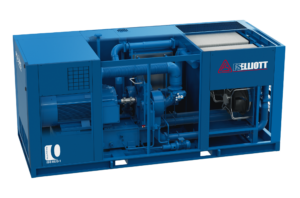
Oil-flooded rotary compressors
Oil-flooded rotary compressors are commonly used in general manufacturing and play a crucial role across industries ranging from automotive to light industrial. Typically operating within a differential pressure range of 9–16 psi and horsepower ratings from 5 to 350 HP, these compressors are well-suited for plants needing single or two-stage compression. Monitoring differential pressure is essential, as pressures exceeding 16 psi indicate that it’s time to schedule maintenance or repairs.
If system pressure exceeds this range, check for:
- Dirty or clogged filters
- Worn separators
- Restricted valves
- Insufficient cooling
Proactive monitoring avoids strain on the compressor and minimizes costly inefficiencies.
Oil-Free Rotary Screw Compressors
These compressors provide oil-free air, making them suitable for sensitive applications such as food and beverage or pharmaceutical production. Their pressure drop averages 5–10 psi.
While oil-free rotary systems reduce contamination risks, their rotor coatings degrade over time, causing:
- Increase interstage pressure
- Reduce flow
- Increased pressure drop over time
Routine inspection of coating conditions is vital to maintaining long-term performance.
Centrifugal air compressors
Centrifugal air compressors deliver high-volume, ISO 8573-1 Class 0 oil-free air and serve heavy-duty applications across pharma, electronics, and chemical manufacturing. With horsepower capacities from 250 to 6,000 HP, these machines offer the lowest total pressure drop as little as 2.5–3.5 psi.
Key advantages:
- Minimal DP due to the absence of separators and coalescing filters
- Fewer mechanical contact points, reducing wear
- Multi-stage compression (up to four stages), enhancing energy efficiency
Centrifugal systems optimize airflow with less resistance, offering superior long-term efficiency and lower operating pressures compared to rotary options.
| Compressor Technology | Oil-Flooded Rotary | Oil-Free Rotary | Centrifugal |
|---|
| Inlet Air Filter | .5 psi | .5 psi | .5 psi |
| Inlet Valve | 1 psi | 1 psi | .5-1 psi |
| Cooler(s) | 1-3 psi | 1-3 psi | 1-2 psi |
| Separator(s) | 4-6 psi | N/A | N/A |
Discharge Coalescing or
Particulate Filter(s) | 2-5 psi | 2-5 psi | N/A |
| Discharge Check Valve | .5 psi | .5 psi | .5 psi |
| Total Pressure Drop | 9-16 psi | 5-10 psi | 2.5-3.5 psi |